Riemann Sphere's and Computability
article
Introduction
Here I explore computable regions of the Riemann sphere $\hat{\mathbb{C}}$. I begin with recalling that definition of $\hat{\mathbb{C}}$ from complex analysis, with particular emphasis on stereographic projection. Then I examine computable analysis, in particular how computability is defined on complete separable metric spaces according to TTE.
Background
I assume knowledge of $\mathbb{C}$. In particular, I assume that readers understand the representation of complex numbers and basic arithmetic in $\mathbb{C}$. I also assume knowledge of basic real analysis.
Riemann Sphere
The Riemann sphere is that projection of the extended complex plane that allows for natural inverses of elements
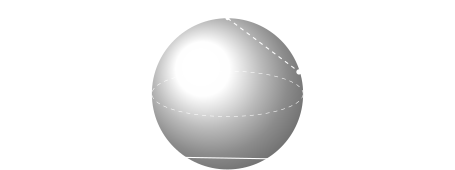
Using the north pole of $S$ denoted $N$, we can create a geometric intuition for distance among points of \(\hat{\mathbb{C}}\). Thus using stereographic projection we can describe a metric space on \(\hat{\mathbb{C}}\), see

The metric space $(\hat{\mathbb{C}}, d)$ is defined in three dimensional space by the coordinate functions in Eq $\eqref{sphere-intersection-equations}$. That is, Each point $Z$ on the sphere correlates to some point $z \in \mathbb{C}$; Such that $Z = (x_1, x_2, x_3)$. Such a metric space necessitates the presence of a metric function $d$ defined by Eq $\eqref{sphere-d}$
It is the case that there is only one point that does not produce an intersection. In particular it should be the case that when $(z_n) \rightarrow \infty$ we should see the equation approach $N$. As $N$ is located at $(0,0,1)$ in this orientation we can continue by testing each equation for $(z_n) \rightarrow \infty$. That is when $(z_n) \rightarrow \infty$ we notice the following:
- $x_1 \rightarrow 0$, as the numerator is lower order than the denominator.
- $x_2 \rightarrow 0$, as the numerator is lower order than the denominator.
- $x_3 \rightarrow 1$, as the numerator and denominator are of equivalent order.
The stereographic projection defines a formal metric space. A metric space as defined in
- $d(x,y) \ge 0$
- $d(x,y) = 0 \iff x = y$
- $d(x,y) = d(y,x)$
- $d(x,z) \le d(x,y) + d(y,z)$
In stereographic projection that metric $d$ is the defined via Eq $\eqref{sphere-d}$ between two points $Z_a$ and $Z_b$.
It is the case that $d$ is non-negative for any $z \in \mathbb{C}$. That is the numerator is bound to a positive value multiplied by two and the denominator is addition of two square positive complex numbers. Unless of course $z = z’$, which results in a zero numerator, thus zero. The commutativity of $d$ is true, as the only problem would be the numerator term $2|z - z’|$. In particular the absolute value term which will always result in an absolute measure, assuring commutativity. The triangular inequality is given as $d$ inherits that those qualities of $\mathbb{R}^3$.
In the last section we showed stereographic projection to produce the description of a metric space over \(\hat{\mathbb{C}}\). Notice that we did this only through description of the sphere, not ignoring the plane but simply not needing to use it. We call this particular sphere $S^2$ or the Riemann sphere, as it is that co-domain of the bijection between \(\hat{\mathbb{C}}\) and $S^2$ derived from stereographic projection.
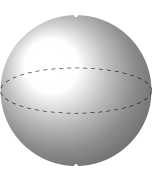
Let us here after define a region to be some open, connected subset of $S^2$. In particular here I mean those open, connected subsets of a Riemann sphere.
Computable analysis
Computable analysis investigates those theorems and functions of classical analysis, with particular interest in their computability. In particular we will find that their exists axioms of computability specifically tied to constructions of classical analysis. It is with these axioms and theorems of computability that we will examine the Riemann sphere in coming sections. The most basic idea in computability is that distinction of which math can be described as computable. Thus we define computability as those mathematical constructions which can be described mechanistically
- Recursively enumerable sets are computable.
- Functions are computable given there inputs can be estimated using their outputs.
- Computability is defined using Turing-machine (or equivalent) logic in Discrete space.
Computable Regions of Riemann sphere
Computability here, describes those processes which can be enumerated via mechanistic logic. Thus for any given Region of the Riemann sphere ($\hat{\mathbb{C}}$) to be considered computable it would have to be describable in some mechanistic logic. In particular it is true that such a region would need to be describable to a Turing machine
- $(M, d)$ the metric space
- $A \subset M$, where $A$ is a dense subset
- $\alpha : \mathbb{N} \rightarrow A$ is a total numbering of $A$
- \(D_< : \{ \langle i,j,k \rangle \mid d( \alpha (i), \alpha (j) ) < v_\mathbb{Q}(k) \}\) is recursively enumerable
Note that the total numbers of $A$ is simply $\mathbb{N}$ projected onto the $A$, that is $A$ is a countable set. The fourth rule is describing that the distance between any two elements, with relation to an associated numbering of the rationals. In particular this rule is only accounting for a single side of the distance, allowing for arbitrary precision of distances
Thoughts and future work
As somewhat of a limitation my understanding of the theory of computability seems to be lacking almost as much analysis. Thus it is now a goal of mine to examine this again after expanding my understanding of the modern research in computability theory. This work is incredibly interesting, due to the nature of computability. Upon starting my research on mathematics in the continuous space (analysis) I believed computability to be impossible. It was my understanding that computable algorithms were limited to discrete space strictly. While it seems to be required to find natural projections to the domain, the rules seem to be less strict than I originally thought. I think I will continue to investigate computability while working through