The Riemann sphere
description of the Riemann sphere with emphasis on how it is derived from the complex plane.
Introduction
Here I give an exposition of the Riemann sphere \(\widehat{\mathbb{C}}\). Beginning with the complex plane $\mathbb{C}$ I explore the necessary background information. I then construct the Riemann sphere $\widehat{\mathbb{C}}$ via a geometric and analytic intuition. In particular the introduction of the extended complex plane and stereographic projection via light proof work. This will present that homeomorphic mapping from the extended complex plane to the Riemann sphere. Finally I explore shallowly that topology of the Riemann sphere that will be used in later articles.
Complex plane
The complex numbers are an extension of $\mathbb{R}$; any $z \in \mathbb{C}$ is composed of two terms one real and one imaginary. That is for any such $z$ it is the case that $z = a + ib$ such that $a,b \in \mathbb{R}$ and $i$ is imaginary. This gives a rather simple geometric intuition wherein we use the two terms to form our axis

Spheres
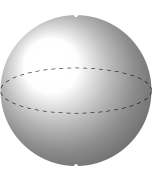
A sphere as we can see from figure 4 is that shape containing no “edges” in the three-dimensional space. Being in a three-dimensional space describing a single point of any sphere requires a three-tuple, some $(x,y,z)$. That is a sphere contains those points lying not only on its surface but those contained inside the extrema as well. Note that some point $(x,y,z)$ need not always be located on a surface. In the context of the discussion that follows, note that a fundamental rule of three-dimensionality is that the sphere contains those points within itself. In particular, if the sphere did not contain those points within or if those points where unreachable then that sphere could be thought of as two dimensional. That is the sphere itself could be treated as a two-dimensional surface projected in three-dimensional space, commonly referred to as $S^2$.
Metric spaces
A metric space describes that relation between some set and a function $(S, d)$. Such that those elements $a,b \in S$ can be described in relation to each other via $d$. That is $d(a,b)$ will represent some metric between $a$ and $b$
- $d(a,b) \ge 0, \forall a,b \in S$
- $d(a,b) = 0 \iff a = b, \forall a,b \in S$
- $d(a,b) = d(b,a), \forall a,b \in S$
- $d(a,c) \le d(a,b) + d(b,c), \forall a,b,c \in S$
Intuition
It is common in analysis and topology to consider transformations with respect to $\infty$. Given the above section on $\mathbb{C}$, assume this is a problem given the asymptotic nature of $\infty$ in $\mathbb{C}$. Thus we create the extended complex plane from
Stereographic projection
Stereographic projection describes a technique for relating a unit sphere to some plane

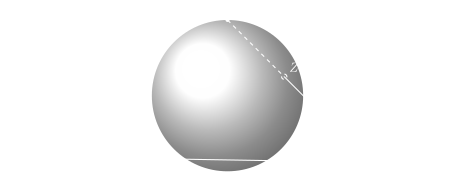
That mapping $z \mapsto Z$ implies a “straight line” $(N, z)$, such that the intersection of $S^2$ is that point $Z$ as shown in figure (2.5). In particular if we take any point on the plane and induce a line $(N, z)$ for some \(z \in \mathbb{C}_\infty\), it is the case that all but one line will pass through the surface of the sphere at some point other than $N$
Notice that as \(z \rightarrow \infty\) the value $f(z) \rightarrow N$ for any value \(z \in \mathbb{C}_\infty\). In particular according to the definition of $f$, as $z \rightarrow \infty$ those coordinate values of $f(z)$ tend to $(0, 0, 1)$ or $N$. Thus providing evidence any line $(N, \infty)$ forma a tangent line on $N$. It is the case here that since the sphere $S^2$ is formed via that transformation of all points in $\mathbb{C}_\infty$, it can be assumed to be bijective
Proposition. $f$ is a bijection
Proof. To show that any function is bijective one must prove that the given function is both surjective and injective. Assume $f$ is not surjective, then there must exist a $z$ such that $f(z) = DNE$ or $f(z_1) = f(z_2)$ The only way this could be true is if the denominator of some coordinate could be zero, $|z|^2$ can be neither zero nor negative. Thus it is impossible for any denominator of the coordinate equations to be zero, The second case is proven through a proof that $f$ is injective. Assume $f$ is not injective, then there must exist some $z_1, z_2 \in \mathbb{C}_\infty : (z_1 \ne z_2) \land (f(z_1) = f(z_2))$. For those points the following must be true:
\[\begin{equation} \label{eq:z1_z2} \begin{split} \frac{|z_1|^2 - 1}{|z_1|^2 + 1} &= \frac{|z_2|^2 - 1}{|z_2|^2 + 1} \\ (|z_1|^2 - 1)(|z_2|^2 + 1) &= (|z_2|^2 - 1)(|z_1|^2 + 1) \\ (|z_1|^2 |z_2|^2 - |z_2|^2 + |z_1|^2) &= (|z_1|^2 |z_2|^2 - |z_1|^2 + |z_2|^2) \\ (|z_1|^2 |z_2|^2 + 2|z_1|^2) &= (|z_1|^2 |z_2|^2 + 2|z_2|^2) \\ |z_1|^2 &= |z_2|^2 \\ z_1 &= z_2 \end{split} \end{equation}\]We find the Eq $\eqref{eq:z1_z2}$ describes a contradiction as the only way for $f(z_1) = f(z_2)$ is that $z_1 = z_2$, therefore $f$ is injective and surjective thus bijective$^\blacksquare$.
Chordal metric
Here I will describe that metric that allows formulation of the distance function between two points of $S^2$. I accomplish this using that metric space $\widehat{\mathbb{C}} := (S^2, d)$ where the function $d$ is the chordal distance. That is the euclidean distance between two points $Z_1, Z_2 \in S^2$
Proposition. \(d(z,z') \ge 0, \forall z,z' \in \mathbb{C}_\infty\)
Proof. The first requirement is \(d(z,z') \ge 0, \forall z,z' \in \mathbb{C}_\infty\). Assume \(\exists z, z_0 \in \mathbb{C}_\infty\) such that $d(z,z_0) < 0$. If such a $z_0$ did exist there is two cases that would result in $d(z,z_0) < 0$. Case one: The numerator of the fraction becomes negative while the denominator remains positive, this is an impossibility. Case two: The denominator of the fraction becomes negative while the numerator remains positive, this is an impossibility. Thus the outcome of the function $d$ must always be non-negative$^\blacksquare$.
Proposition. $d(z, z’) = 0 \iff z = z’$.
Proof. Assume \(\exists z, z_0 \in \mathbb{C}_\infty\) such that $(z \ne z_0) \land (d(z,z_0) = 0)$. Given the denominator of a fraction can not be zero, and it is impossible for the denominator of $d$ to be zero. For this to be true the numerator must result in zero. Thus $2|z - z_0| = 0$, it is sufficient to show that $|z - z_0| = 0$. As \(z, z_0 \in \mathbb{C}_\infty\) the prior statement is impossible unless $z = z_0$. Therefore It is a contradiction to assume $\exists z, z_0 \in \mathbb{C}_\infty$ such that $(z = z_0) \land (d(z, z_0) = 0)^\blacksquare$.
Propostion. \(d(z,z') = d(z',z), \forall z, z' \in \mathbb{C}_\infty\)
Proof. Given that multiplication is commutative the denominator again does not matter. Thus it must be proven that $|z-z’| = |z’-z|$, as it happens subtraction inside of an absolute value is also commutative. Therefore $d$ meets the axiom of symmetry$^\blacksquare$.
Propostion. \(d(z,z'') \le d(z,z') + d(z,z''), \forall z,z',z'' \in \mathbb{C}_\infty\)
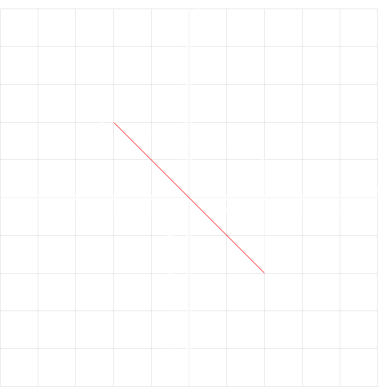
Proof. The geometric representation of the function $d(a,b)$ is that straight line from $a$ to $b$ in $\mathbb{R}^3$. It can then be assumed that three points would form a triangle, which can be represented on a plane by figure 3. Thus any three points of $\widehat{\mathbb{C}}$ such that the function $d$ maps them all in the form of the proposition above will form a triangle. Observe one such triangle depicted in figure 3. In particular, it is impossible for such a shape to have a side length larger than the sum of the two others. That is for any triangle with arbitrary side lengths ${a,b,c}$ it is an impossibility that $a > b+c$, thus it must be true that $a \le b+c$ as in the case of the current proposition$^\blacksquare$.
Thus we prove that the chordal metric $d$ can be used to form the metric space $(\widehat{\mathbb{C}}, d) \equiv (S^2, d)$. That metric space \(\widehat{\mathbb{C}}\) is referred to as the Riemann sphere
Topology
It is the case that \(\widehat{\mathbb{C}}\) is a compactification of $\mathbb{C}$. To understand this we must examine those aspects of $\mathbb{C}$ which make it non-compact. In particular for $\mathbb{C}$ to be compact it must be complete, thus it must contains all the limit points of its convergent subsets
Proposition. \(\widehat{\mathbb{C}}\) is compact
Lemma 1. A set is compact if all infinite subsets contain a limit point
Lemma 2. Weierstrass-Bolzano: If S is an infinite bounded set of real numbers, then S has a point of accumulation
Proof. Consider all infinite $X \subset \widehat{\mathbb{C}}$. The set $X$ may either be bounded or unbounded.
Case bounded. If $X$ is bounded then it contains a subsequence $(x_n) \subset X$ such that $(x_n)$ is convergent by Lemma 2.
Case unbounded. If $X$ is unbounded then there exists a sequence $(x_n) \subset X$ such that $(x_n) \rightarrow \infty$. Recall that $\infty$ is treated as an ordinary point in $\widehat{\mathbb{C}}$.
Given that for all infinite sets $X \subset \widehat{\mathbb{C}}$ there exists some sequence $(x_n) \subset X$ by Lemma 1 $\widehat{\mathbb{C}}$ is compact$^\blacksquare$.
Nomenclature
- \(\mathbb{C}\): symbol representing the complex numbers.
- \(\widehat{\mathbb{C}}\): symbol representing the Riemann sphere.
- \(\mathbb{R}\): symbol representing the real field.
- \(x \in X\): $x$ is an element of the set $X$.
- \(P \implies Q\): the truth of the proposition P implies the truth of the proposition Q.
- \(P \iff Q\), $P$ iff $Q$: P is the true if and only if Q is true.
- \(\widehat{\mathbb{C}}\): symbol for the Riemann sphere.
- \(\forall x \in S\): “forall”, meaning $x$ represents all elements of $S$ recursively.
- \((x_n)\): denotes a sequence of size $n$.
- \((x_n) \rightarrow x\): the sequence $(x_n)$ converges to limit point $x$.
- \(\exists x \in X\): there exists some element $x$ contained in the set $X$.
- Eq (x): is a reference so some equation labeled numerically “x” in the document.
- \(P \land Q\): read “P and Q” logical and means the statement is only true when both proposition P and Q are true.